by SWFL Land
You can legally sell your own land in Florida without a Realtor. Florida law exempts owners selling their own property from real estate licensing. To do it well you need to confirm your title, price the lot from real comparable sales, market it, sign a written vacant land contract, and close through a Florida title company or real estate attorney. That closing office collects the documentary stamp tax (70 cents per $100 of the price in most counties), prorates property taxes, records the deed and files the IRS Form 1099-S.
Below are the steps in order, the seller closing costs to expect, and the places by-owner deals usually go wrong. This is general information, not legal or tax advice.
Can You Sell Land in Florida Without a Realtor?
Yes. Section 475.011 of the Florida Statutes exempts an owner who “sells, exchanges, or leases its own real property” from the real estate license law. It does not cover a business that pays commissioned salespeople to sell lots to the public as an ongoing operation.
A title company handles the closing whether or not an agent is involved. Without an agent, the pricing, marketing, buyer calls and deadlines are yours.
How to Sell Land by Owner in Florida: 9 Steps
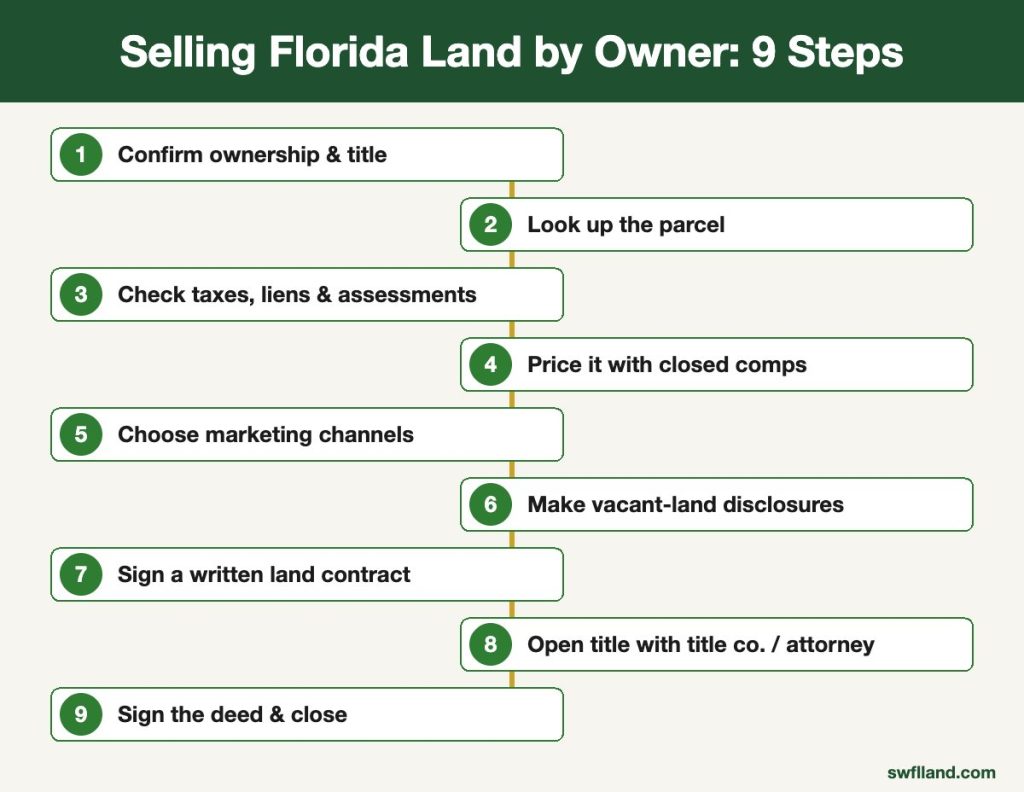
Step 1: Confirm Ownership and Title
Start by finding the deed that put the land in your name. You can usually search the county clerk’s official records or check the “owner” field on the property appraiser’s site. Make sure the names on the deed match the people who will sign. If a co-owner has died, or the land is still titled to a parent, the sale can’t close until that is fixed. Our guide to selling inherited land in Florida covers probate and the other ways heirs clear title.
Look for anything else recorded against the parcel: old mortgages that were paid but never satisfied of record, judgments, lis pendens, or a code enforcement lien. Only a title search finds all of these, so many sellers order one before they list.
Step 2: Look Up the Parcel on the County Property Appraiser Site
Every Florida county has a property appraiser with a free parcel search. Pull your parcel’s record and write down:
- the parcel ID (strap or folio number) and legal description
- lot size and dimensions
- land use code and zoning
- the just value, which is useful context but is not a sale price
- recent sales of nearby parcels
In Lee County, our walkthrough on how to find who owns a lot in Lee County shows how to use the Lee County Property Appraiser search.
Step 3: Check Taxes, Liens and Special Assessments
Under section 197.122, Florida Statutes, property taxes are a first lien on the land from January 1 of the tax year. That lien is superior to all other liens. Taxes are due November 1 and become delinquent April 1 of the following year (section 197.333). Check the county tax collector’s site for unpaid years and for any tax certificates sold against the parcel. If you are behind, read how to sell land with back taxes in Florida before you set a price, because the payoff comes out of your proceeds at closing.
Also look for non-ad valorem assessments such as utility extension, road, drainage and MSTU charges. In some areas these are a large part of a lot’s real cost. Buyers and title companies will find them, so it is better to know about them first. Open code cases matter too, and the next sections cover them. If your parcel has one, see selling land with code liens.
Step 4: Price the Land with Real Comparable Sales
Just value, automated estimates and asking prices are not comps. Real comps are recent closed sales of similar lots nearby. “Similar” means the same size, the same utility situation (city water and sewer versus well and septic), a similar flood zone, similar road access and similar buildability.
Our step-by-step guide on how to comp vacant land shows how to pull sales from county records and adjust them. For a fast starting point, try the What’s My Lot Worth tool. Before you list, run through the Florida land due diligence checklist. Serious buyers will check flood zone, wetlands, access and utilities, and those items can move the price a lot.
Step 5: Choose Where to Market It
Most by-owner land sellers combine several channels:
- Flat-fee MLS listing. A licensed broker puts your lot on the local MLS for a set fee. You still handle the showings and negotiation. Ask in writing what the fee includes and whether you are offering any compensation to a buyer’s agent.
- Land marketplaces and classifieds. Online land listing sites reach out-of-area investors and builders. Include photos, a parcel map and the parcel ID.
- A sign on the lot. Still effective in active subdivisions; check local sign rules.
- Neighbors and builders. Adjacent owners are often the best buyers for small, oddly shaped or landlocked land.
- Direct buyers. Cash land buyers make offers without a listing, giving you a quick number to compare.
If a buyer asks you to carry the note, read our page on selling land with owner financing before you agree. The note, mortgage and default terms need to be drafted correctly.
Step 6: Make the Disclosures That Apply to Vacant Land
Florida’s disclosure rules are more limited for vacant land than for houses, but they are not zero.
- Known material defects. The Florida Supreme Court’s decision in Johnson v. Davis created a duty to disclose known facts that materially affect value. The case involved the sale of a home, and Florida Realtors describes the rule in residential terms, so how far it reaches for vacant land is less settled. The safe practice is still to disclose in writing what you know: fill, dumping, a known access dispute, or an open code case. Hiding a known problem invites a fraud claim.
- Code enforcement cases. If a code enforcement proceeding is pending when you transfer the property, section 162.06(5) requires written disclosures to the buyer before closing, copies of the case papers, and a notice to the code official within 5 days after the transfer. The statute applies to “property” generally, not just homes. Skipping the disclosure creates a rebuttable presumption of fraud.
- HOA disclosure summary. If the lot is in a community with a mandatory homeowners’ association, section 720.401 requires a disclosure summary before the buyer signs the contract.
- Flood disclosure. Section 689.302 requires a seller of “residential real property” to give the buyer a flood disclosure at or before contract. The form asks about flood damage during your ownership, flood insurance claims and federal flood assistance. The statute does not define “residential real property” and does not mention vacant lots. Ask your closing agent whether to use the form for a residential-zoned lot. Giving it costs little.
- Property tax disclosure. Section 689.261 applies to “residential property” and warns buyers that taxes may change after a sale.
- Radon. Florida Realtors notes that the radon disclosure under section 404.056(5) applies to buildings, not unimproved land.
Step 7: Sign a Written Vacant Land Contract
Florida land sales should always be on a written contract. Florida Realtors publishes a Vacant Land Contract (form VAC-15, updated in January 2026). This is a different form from the FR/BAR residential contract used for homes. Title companies and attorneys work with it every day, and an attorney can also draft a custom agreement. The contract should spell out:
- the price, the escrow deposit and who holds it
- the due diligence or feasibility period and how the buyer can cancel
- the closing date and the closing agent
- who pays each closing cost, including the owner’s title policy
- how taxes and assessments are prorated, and who pays pending versus certified assessments
- the type of deed you will deliver
Step 8: Open Title with a Florida Title Company or Attorney
Once the contract is signed, send it to a Florida title company or a real estate attorney who handles closings. They search title, issue a title commitment, order lien and tax payoffs, prepare the deed and settlement statement, collect and disburse funds, and record the deed. Title insurance premiums in Florida are set by state rule (Rule 69O-186.003, Florida Administrative Code), so the premium itself does not change from one company to another. Settlement and search fees do vary, so ask for a written fee quote.
Pick a title company when the deal is clean. Bring in an attorney if title has gaps, if heirs need to be sorted out, or if you are carrying financing.
Step 9: Sign the Deed and Close
Under section 689.01, a Florida deed must be signed in front of two subscribing witnesses and notarized. For the clerk to record it, section 695.26 requires the printed names and post office addresses of the signers and witnesses, plus the preparer’s name and address. Your closing agent will prepare the deed so it meets these rules.
The common deed types are a warranty deed, which gives the broadest promises about title, a special warranty deed, which covers only your period of ownership, and a quitclaim deed, which makes no promises. Buyers usually expect a warranty or special warranty deed.
Closing Costs When You Sell Land in Florida
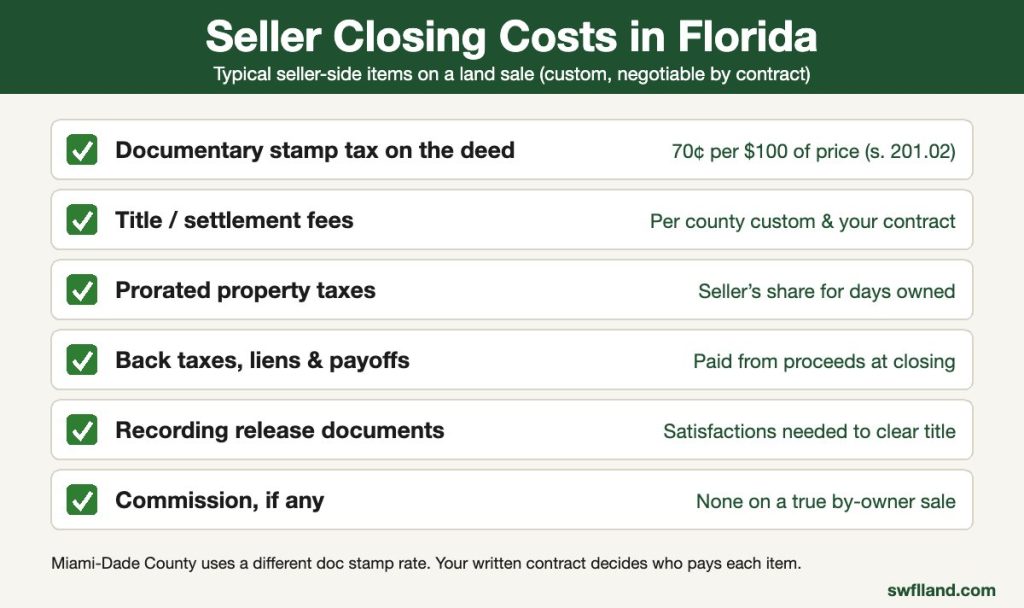
Who pays what in Florida is set mostly by local custom and the contract, not by law. The one statewide number is the deed tax. Under section 201.02, documentary stamp tax on a deed is 70 cents per $100 of the price. Miami-Dade County uses its own rate structure. Florida DOR says all parties are liable for the tax no matter which one agrees to pay it, but by custom the seller usually pays it.
| Item | Usually paid by | Notes |
|---|---|---|
| Documentary stamp tax on the deed | Seller (by custom) | 70 cents per $100 of price (s. 201.02); Miami-Dade differs |
| Owner’s title insurance policy | Varies by county custom | Premium rates set by state rule; the contract decides who pays |
| Settlement / closing fee | Negotiable | Often split or assigned in the contract |
| Prorated property taxes | Both | Seller pays its share for the days it owned the land that year |
| Delinquent taxes, liens, payoffs | Seller | Paid from your proceeds at closing |
| Recording releases and satisfactions | Seller | Documents needed to clear title |
| Recording the deed | Buyer (by custom) | Negotiable |
| Commission | Seller, if any | None on a true by-owner sale unless you agree to pay a buyer’s agent |
Read your settlement statement line by line before you sign.
Taxes and Paperwork: 1099-S and FIRPTA
Form 1099-S. The IRS treats “improved or unimproved land” as reportable real estate. The person responsible for closing, normally the settlement agent, files Form 1099-S. You will be asked to give your taxpayer ID and certify it. Talk to a tax professional about any capital gain.
FIRPTA. If the seller is a foreign person under U.S. tax law, the buyer generally has to withhold 15% of the amount realized and send it to the IRS. The $300,000 exception requires the buyer to live in the property as a residence, so it rarely fits a vacant land sale. Foreign sellers should involve a tax advisor early.
Selling from Out of State: Remote Online Notarization
Many Florida lot owners live up north or overseas. Under section 117.265, a Florida online notary who is physically in Florida can notarize your signature by two-way audio-video wherever you are located. The notary has to confirm your identity, usually by checking a government ID remotely, running credential analysis and asking identity-proofing questions. Section 689.01(2) also allows deed witnesses to appear by audio-video. Ask your title company whether it offers remote closings; the alternative is signing originals before a local notary and two witnesses. If you own a lot in Lehigh Acres or Cape Coral and haven’t seen it in years, a remote closing can save you a trip.
By Owner vs. Listing with an Agent vs. Selling to a Cash Buyer
| Sell by owner | List with an agent | Sell to a cash buyer | |
|---|---|---|---|
| Commission | None, unless you pay a buyer’s agent | Negotiated with the listing broker | None |
| Your workload | Highest | Lower | Lowest |
| Price | Market price, if you price and market it well | Market price, with wider exposure | Usually below retail in exchange for speed and certainty |
| Speed | Depends on demand and your marketing | Depends on demand | Often the fastest |
| Title problems, liens, back taxes | You solve them before closing | Agent helps, but you still solve them | Many buyers will work through them |
For a fuller breakdown, including what happens if land goes to tax deed, read cash buyer vs. listing vs. tax deed.
If you would like a number to compare against before you do all the work of a by-owner sale, SWFL Land buys land directly in Lee County, Collier County, Charlotte County, Sarasota County, Hendry County and Marion County. Owners usually get a written offer within 24 hours. You can request a cash offer or call 239-686-0823. There is no obligation.
Common Mistakes When Selling Land by Owner
- Pricing from the just value or an automated estimate instead of closed comps.
- Not checking assessments and code cases until the buyer’s title search finds them.
- Using a bare-bones internet contract with no due diligence, deposit or closing cost terms.
- Holding the deposit yourself. Have the title company or attorney hold escrow.
- Recording a homemade deed that is missing witnesses, addresses or a correct legal description.
- Accepting wires or checks outside of closing. All money should move through the closing agent. Verify wire instructions by phone.
How Long Does It Take to Sell Land by Owner in Florida?
Most of the time goes to finding the buyer, which depends on location, price and access. Buildable lots with utilities move faster than remote or wet acreage. Once a contract is signed, the due diligence and closing dates in it set the pace, and cash deals with clean title usually close faster than financed ones. Title problems, such as an unprobated estate, an unreleased mortgage or a code lien, cause the most delay, so start on those first.
Frequently Asked Questions
Do I need a real estate license to sell my own land in Florida?
No. Section 475.011, Florida Statutes, exempts an owner selling its own real property from the license law. The exemption does not cover running an ongoing lot sales business through commissioned salespeople.
Do I need a lawyer to sell land by owner in Florida?
Not legally. Most clean land sales close through a Florida title company, which prepares the closing documents and records the deed. An attorney is worth hiring when title has problems, when heirs or probate are involved, or when you are carrying financing.
How much is the documentary stamp tax when selling land in Florida?
Seventy cents per $100 of the sale price under section 201.02, Florida Statutes, except in Miami-Dade County, which has its own rate. By custom the seller usually pays it, but the contract can say otherwise.
What closing costs does a seller pay on a Florida land sale?
Typically the deed documentary stamp tax, the seller’s share of prorated property taxes, payoffs of any liens or back taxes, recording of releases needed to clear title, and any commission you agreed to. The owner’s title policy and settlement fees depend on county custom and the contract.
Does Florida’s flood disclosure law apply to vacant land?
Section 689.302 applies to sellers of “residential real property” and does not define that term or mention vacant lots. Ask your closing agent about a residential-zoned lot. Many sellers provide the form because it costs nothing and protects them.
Can I sell my Florida land if I live in another state?
Yes. Florida allows remote online notarization by a registered Florida online notary under section 117.265, and deed witnesses can appear by audio-video. Many title companies close out-of-state sellers entirely remotely.
Who files the 1099-S on a Florida land sale?
The person responsible for closing, normally the title company or attorney acting as settlement agent. You will be asked for your taxpayer ID at or before closing.
Is selling to a cash land buyer better than selling by owner?
It depends on what matters to you. Selling by owner can get a higher price if you have the time and the title is clean. A cash buyer trades some price for speed, certainty and less work. SWFL Land usually makes a written offer within 24 hours and closes through a Florida title company, and the offer spells out who pays each closing cost.
Sources
- Florida Statutes s. 475.011 (license exemptions, owner selling own property)
- Florida Statutes s. 201.02 (documentary stamp tax on deeds)
- Florida Department of Revenue, Documentary Stamp Tax overview
- Florida Department of Revenue, Documentary Stamp Tax
- Florida Statutes s. 197.122 (taxes as first lien)
- Florida Statutes s. 197.333 (when taxes are due and delinquent)
- Florida Statutes s. 162.06 (transfer of property subject to code enforcement)
- Florida Statutes s. 720.401 (HOA disclosure summary)
- Florida Statutes s. 689.302 (flood disclosure)
- Florida Realtors, Florida Expands Flood Disclosures (2025)
- Florida Statutes s. 689.261 (property tax disclosure, residential property)
- Florida Realtors, Florida Real Estate Disclosure Laws (Johnson v. Davis, radon)
- Florida Realtors, new and updated forms including Vacant Land Contract VAC-15 (Jan. 2026)
- Fla. Admin. Code R. 69O-186.003 (title insurance rates)
- Florida Statutes s. 689.01 (conveyances, two subscribing witnesses)
- Florida Statutes s. 695.26 (requirements for recording instruments)
- Florida Statutes s. 117.265 (online notarization procedures)
- IRS, Instructions for Form 1099-S
- IRS, FIRPTA Withholding
Land Seller Guides by County
Researched guides from the SWFL Land Resource Center:
- Selling vacant land in Lee County
- Selling vacant land in Collier County
- Selling vacant land in Charlotte County
- Selling vacant land in Sarasota County
- Selling vacant land in Hendry County
- Selling vacant land in Marion County
- Selling vacant land in Miami-Dade County
- Selling vacant land in Monroe County (Florida Keys)
Wholesalers and agents: see our land buy box and guide to wholesaling land in Florida.