by SWFL Land
A Lehigh Acres lot is worth what similar vacant lots nearby have actually sold for in the last 6 to 12 months, adjusted for utilities, road paving, drainage, flood zone and size. The Lee County Property Appraiser’s just value and online estimates are starting points, not prices. To get a real number, pull recent vacant-lot sales from leepa.org or the MLS, compare lots that match yours on the factors below, and then decide whether to list, sell it yourself or take a cash offer.
This guide explains how to do that step by step, with no made-up price ranges. If you would rather get a number now, try our instant lot value tool or ask for a written offer on our Lehigh Acres land buying page.
Lehigh Acres Basics for Lot Owners
Lehigh Acres is not a city. It is an unincorporated census-designated place in eastern Lee County, so zoning, building permits, road paving and code enforcement are handled by Lee County, not a city hall. The 2020 Census counted 114,287 residents on about 92.7 square miles of land.
The community started in 1954, when Chicago businessman Lee Ratner turned a cattle ranch into a land sales project. The land was divided into roughly 152,000 lots, most of them a quarter acre to a half acre, served by more than 1,400 miles of roads. As late as 1997, nearly 90% of those lots were still vacant. A 1996 commercial land use study prepared for Lee County put it plainly: most of the land was “platted into separate building lots and sold to individuals around the world.”
That is why so many Lehigh lots are owned by people who have never seen them, and why the same issues keep coming up: wells and septic, unpaved roads, drainage and back taxes. For the bigger county picture, see our Lee County land guide.
| Lehigh Acres fact | What it means for value |
|---|---|
| Unincorporated Lee County | County rules govern zoning, permits, paving and mowing |
| About 152,000 platted lots, mostly 1/4 to 1/2 acre | Lots of similar inventory, so buyers compare closely |
| Population of 114,287 (2020), up from about 87,000 in 2010 | Steady home building keeps builder demand alive |
| Only about 2% of land zoned commercial (1996 study) | Commercial parcels are scarce and priced differently |
| Drainage district on the tax bill | A yearly non-ad valorem assessment follows the lot |
What Drives Lehigh Acres Lot Value
Two quarter-acre lots a mile apart can sell for very different amounts. Buyers check the same factors every time.
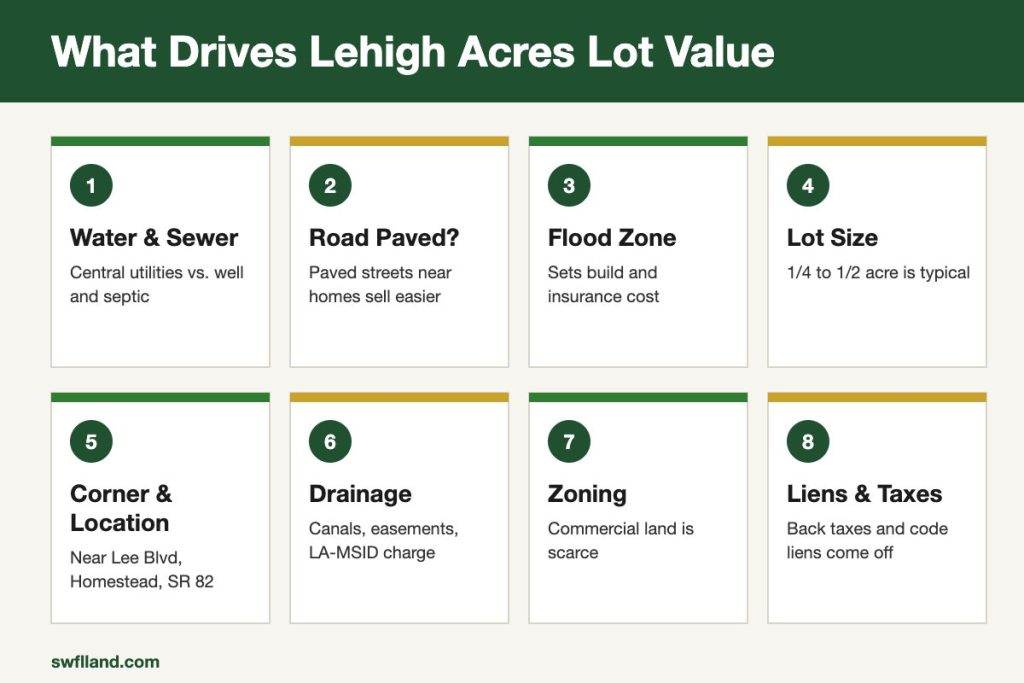
Water and sewer vs. well and septic
This is often the biggest single factor. The Florida Governmental Utility Authority (FGUA) runs central utilities in parts of Lehigh and is studying how to expand its wastewater service area along Lee Boulevard as part of a septic-to-sewer program. Everywhere else, a new home needs a private well and a septic system.
That adds cost and time. The Florida Department of Health in Lee County requires a site survey with every septic application and says all new septic applications in unincorporated Lee County must be designed by a Florida licensed professional engineer. A lot with central water and sewer at the street skips that step.
Paved road vs. unpaved road
Lee County DOT maintains about 1,500 miles of paved roads in Lehigh, but many streets are still unpaved. In December 2024 the county approved a contract to pave 62 unpaved road segments, about 13.9 lane miles. Roads are ranked each year by condition and the number of homes on them, and paving is funded mostly from gas tax revenue, not a charge to owners. A lot on a paved street near existing homes is easier to finance, build on and sell.
Drainage district and canals
Lehigh’s canals and drainage are managed by the Lehigh Acres Municipal Services Improvement District (LA-MSID). The Legislature created it in 2015 and dissolved the old East County Water Control District, moving its assets and duties to the new district. LA-MSID charges non-ad valorem assessments that are collected along with county taxes. Its finance page lists assessments of $172.48 per acre. Check your own tax bill for your lot’s exact charge.
Local news has reported impassable Lehigh streets during heavy summer rain, so builders look closely at drainage and at lots beside canals or drainage easements.
Flood zone
Lehigh is inland, but flood zones still vary from street to street. Look up your lot on Lee County’s Find My Flood Zone map or the FEMA Flood Map Service Center. A lot in a minimal-risk zone is cheaper to build on and insure than one in a special flood hazard area, and buyers price that in.
Lot size, shape and location
- Size. Most lots are a quarter to a half acre. Larger or side-by-side lots appeal to buyers who want room. Confirm acreage on the Property Appraiser record.
- Corner lots. More design options, but two frontages and more setbacks.
- Location. Lots near established homes, schools and shopping along Lee Boulevard, Homestead Road, Gunnery Road and State Road 82 generally get more attention than lots in the far reaches with few rooftops.
Commercial zoning
The 1996 study found only about 2% of Lehigh land had commercial zoning, compared with a typical 5%. A September 2026 Gulfshore Business report said the community still needs more commercial development, with a Walmart-anchored center planned at its southern edge and State Road 82 named as a likely area for future commercial investment. If your parcel has commercial zoning, do not price it like a homesite. Comp it against other commercial land.
Builder costs
Builders work backward from the finished home’s sale price, subtracting construction, well and septic or utility hookup, permits and Lee County impact fees. Impact fees are due when the building permit is issued, and the current schedule is in Chapter 2 of the Lee County Land Development Code. When those costs rise, the amount a builder can pay for the lot goes down.
| Factor | Where to check it | Effect on buyers |
|---|---|---|
| Central water and sewer | FGUA or a call to the utility | Removes well and septic cost |
| Road paved | Street view, Lee County DOT | Easier access and financing |
| Flood zone | Lee County Find My Flood Zone, FEMA map | Changes build and insurance cost |
| Lot size | leepa.org parcel record | Room for a larger home |
| Drainage assessment | Tax bill on the Lee County Tax Collector site | Ongoing cost to the owner |
| Zoning | Lee County DCD, leepa.org | Residential vs. commercial value |
| Liens and back taxes | Tax Collector, Clerk records | Paid off from the sale price |
What It Costs to Keep a Vacant Lehigh Lot
Most Lehigh lot owners pay three kinds of holding costs every year.
Property taxes
Lee County tax bills go out in the fall. Under Florida law, you get a 4% discount for paying in November, 3% in December, 2% in January and 1% in February. Taxes become delinquent April 1. After that, the Lee County Tax Collector can sell a tax certificate on your lot, and a certificate holder can later apply for a tax deed. If you are already behind, read our guide to selling land with back taxes in Florida.
The LA-MSID assessment
The drainage district charge appears on the same tax bill. It is not based on the lot’s value, so it does not drop when the market does.
Mowing and code enforcement
Lee County’s lot mowing ordinance requires grass and weeds to be kept at 12 inches or less on covered lots near developed property. If an owner does not cut it after notice, the county can mow it and bill the owner for the cost plus an administrative fee. Unpaid bills become recorded liens. Absentee owners often learn of them at closing. See how to sell land with code liens.
How to Look Up Your Lehigh Acres Parcel
- Go to leepa.org, the Lee County Property Appraiser’s site, and search by owner name, address or STRAP number. The STRAP is Lee County’s parcel ID and appears on your tax bill.
- Write down the owner of record, legal description, acreage, land use code and just value.
- Check the sales history to see what you or the prior owner paid.
- Open the Tax Collector record to see whether any taxes or certificates are unpaid.
- Check the flood zone and confirm whether the street is paved.
If the owner of record is a relative who has died, or a name you do not recognize, see how to find who owns a lot in Lee County. Heirs should also read our guide to selling inherited land in Florida.
How to Comp Your Lehigh Lot in 5 Steps
Comparable sales are the only reliable way to price a lot. Our full guide on how to comp vacant land goes deeper.
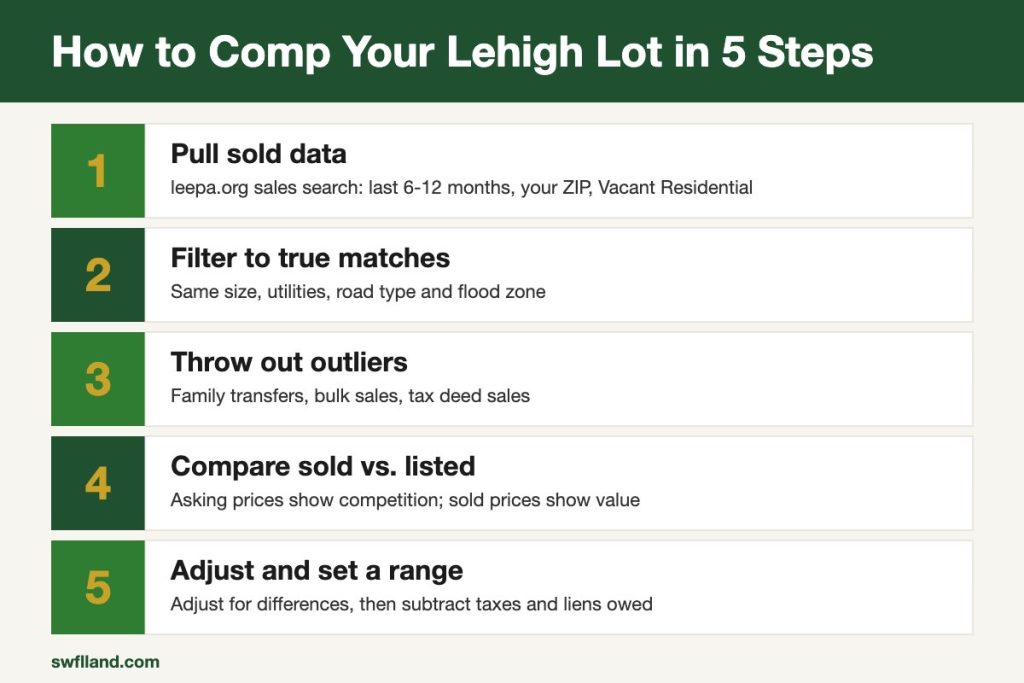
- Pull sold data. Use the leepa.org Sales List Generator. Choose a sale date range of the last 6 to 12 months, pick your ZIP code (Lehigh’s standard ZIP codes are 33936, 33971, 33972, 33973, 33974 and 33976), and set the property type to Vacant Residential (DOR 00). If you work with an agent, ask for MLS sold land data too.
- Filter to true matches. Keep lots of similar size with the same utility situation (well and septic or central), the same road type (paved or unpaved) and a similar flood zone.
- Throw out the outliers. Remove sales between family members, very low-dollar transfers, bulk sales of many lots, and tax deed sales. They do not reflect a normal open-market price.
- Compare sold to listed. Look at what is for sale now on your street and in your area. Asking prices show competition. Sold prices show value. If many similar lots sit unsold, the asking prices are too high.
- Adjust and set a range. Adjust for differences such as a paved road, nearby homes, a canal, or a corner. Then subtract anything owed on the lot, such as back taxes or liens.
The same method works in Cape Coral; see what your Cape Coral lot is worth.
Why Your Tax Value Is Not Your Sale Price
The Property Appraiser sets each parcel’s just value as of January 1 each year. Florida law treats just value as market value, but it is a mass appraisal across the whole county, not an appraisal of your specific lot. It misses things a buyer sees, like a flooded street in August.
Assessed value can also be lower than just value. For non-homestead property, Florida limits the yearly rise in assessed value to 10%. That cap ends when the property sells. The tax record can lag real sales in either direction. Use it to identify your lot, not to price it.
Not sure where to start? Our free lot value tool gives you a quick estimate, and you can request a written cash offer for comparison. Offers usually come within 24 hours.
Your Options to Sell a Lehigh Acres Lot
| Option | Best for | Trade-off |
|---|---|---|
| List with a local agent | Clean, buildable lots on paved roads | Commission and time on market |
| Flat-fee MLS listing | Owners who want MLS exposure and will handle showings and offers themselves | You do more of the work |
| Land listing websites | Owners comfortable marketing on their own | Slower, more screening of buyers |
| Direct cash buyer | Out-of-state owners, heirs, lots with back taxes or liens | Usually below full retail in exchange for speed and certainty |
| Owner financing | Owners who want monthly income and a higher price | You wait to be paid in full |
For a side-by-side look, read cash buyer vs. listing vs. tax deed. If you would like steady payments instead of a lump sum, see how we handle owner-financed land sales. Wholesalers with Lehigh contracts can see how we buy Lee County wholesale land deals.
We also buy outside Lehigh, including rural acreage in Alva and infill lots in Fort Myers. See all of our Lee County land buying areas.
Tips for Out-of-State Lehigh Owners
- Gather paperwork: deed or leepa.org record, STRAP number and latest tax bill.
- Pay attention to the tax bill. A missed bill sent to an old address can lead to a tax certificate on your lot.
- Sign up for fraud alerts with the Lee County Clerk (details below).
- Sign by mail. Most Florida title companies can send closing documents for you to sign in front of a notary where you live.
- Ask who pays what. Florida charges documentary stamp tax on deeds of 70 cents per $100 of the price. Your contract decides who pays it and every other closing cost.
Our full guide on selling a Lehigh Acres lot from out of state covers each step.
Red Flags: Scam Offers and Deed Fraud
Vacant lots with absentee owners are a favorite target for fraud. The Royal Palm Coast Realtor Association reported five fake vacant-lot sales in Southwest Florida within 48 hours, where scammers posed as the owners. Protect yourself:
- Sign up for the Lee County Clerk’s property fraud alert. It is free and emails you, usually within a day, when a deed, mortgage or other land record is recorded under your name or parcel ID. It cannot stop a fake deed from being filed, but it lets you act fast.
- Verify the title company. Call it at a number you find yourself, never one from an email, and never trust emailed wire instructions.
- Never pay a buyer up front. A real buyer does not need an “appraisal fee,” “processing fee” or “listing fee” from you before closing.
- Get everything in writing. A real offer names the buyer, the price, the closing timeline, the title company and who pays each closing cost.
What Affects Your Offer From a Cash Buyer
A cash buyer starts from comparable sales, then accounts for:
- Utilities: central water and sewer or well and septic
- Paved or unpaved road and nearby homes
- Flood zone, drainage and any canal or easement
- Back taxes, tax certificates, code liens and the drainage assessment
- Title issues such as heirs, missing signatures or old mortgages
- How quickly the lot could be resold or built on
At SWFL Land, a d/b/a of Libera Capital Group LLC, we buy Lehigh lots directly, including lots with back taxes, code liens or probate issues. Offers usually come within 24 hours. The written offer spells out who pays each closing cost, and every sale closes through a Florida title company. Get a cash offer on your Lehigh Acres lot or call 239-686-0823.
Frequently Asked Questions
How much is my lot worth in Lehigh Acres?
It is worth what similar vacant lots near you have sold for recently. Pull the last 6 to 12 months of vacant residential sales on leepa.org or the MLS, match them on size, utilities, road paving and flood zone, then subtract anything owed on the lot.
Is the Lee County Property Appraiser’s value what my lot will sell for?
Not necessarily. The just value is a mass appraisal as of January 1, and assessed value can be capped below it. Recent comparable sales are a better guide to price.
Do Lehigh Acres lots have city water and sewer?
Some do. FGUA provides central utilities in parts of Lehigh Acres, but many lots still need a private well and septic system. In unincorporated Lee County, new septic applications must be designed by a Florida licensed engineer.
What is the LA-MSID charge on my tax bill?
It is a non-ad valorem assessment from the Lehigh Acres Municipal Services Improvement District, which replaced the East County Water Control District in 2015 and manages drainage and canals. The district’s finance page lists assessments of $172.48 per acre.
Can I sell my Lehigh Acres lot if the taxes are behind?
Yes. The title company pays the delinquent taxes and any tax certificates from the sale proceeds at closing, as long as the lot has not already been sold at a tax deed auction.
Does a paved road make my lot worth more?
Usually, yes. A paved road makes a lot easier to reach, finance and build on. Lee County paves unpaved Lehigh roads over time, ranking them by condition and the number of homes on them.
How do I protect my vacant lot from deed fraud?
Sign up for the Lee County Clerk’s free property fraud alert, which emails you when a document is recorded under your name or parcel ID. Also check your tax bill every year.
How fast can I sell my Lehigh Acres lot for cash?
With SWFL Land, offers usually come within 24 hours. The closing date depends on title work, which a Florida title company handles, and on clearing any liens or heir issues.
Sources
- U.S. Census Bureau QuickFacts: Lehigh Acres CDP, Florida
- Lehigh Acres, Florida (history)
- Lehigh Acres Commercial Land Use Study (1996): Executive Summary
- Gulfshore Business: Lehigh Acres growth demands more commercial development (Sept. 2026)
- Laws of Florida 2015-202: Lehigh Acres Municipal Services Improvement District
- LA-MSID: About the District
- LA-MSID: Finance
- FGUA: Lehigh Acres Septic to Sewer Project
- Florida Department of Health in Lee County: New Septic (OSTDS) Permit
- Lee County: Commissioners approve project to pave 62 road segments in Lehigh Acres
- Lee County DOT: How do I get my road paved?
- Lee County DCD: Impact Fees
- Lee County Ordinance 14-08: Lot Mowing
- WINK News: Lehigh Acres roadways flood
- Lee County GIS: Find My Flood Zone
- FEMA Flood Map Service Center
- Lee County Property Appraiser: FAQ
- Lee County Property Appraiser: Sales List Generator
- ZIP Codes for Lehigh Acres, FL
- Florida Statutes s. 197.162: Discounts for early payment
- Florida Statutes s. 197.333: When taxes due; delinquency
- Florida Statutes s. 197.502: Application for tax deed
- Lee County Tax Collector: Tax Certificate Sale
- Florida Statutes s. 201.02: Documentary stamp tax on deeds
- Lee County Clerk: Property Fraud Alert
- WGCU: Lee County offers free property fraud alert (April 2025)
- Fox 4: Realtors sound alarm after five vacant lot scams in two days
Land Seller Guides by County
Researched guides from the SWFL Land Resource Center:
- Selling vacant land in Lee County
- Selling vacant land in Collier County
- Selling vacant land in Charlotte County
- Selling vacant land in Sarasota County
- Selling vacant land in Hendry County
- Selling vacant land in Marion County
- Selling vacant land in Miami-Dade County
- Selling vacant land in Monroe County (Florida Keys)
Wholesalers and agents: see our land buy box and guide to wholesaling land in Florida.